
Backlinks, which are links from other websites to yours, are one of the main ways search engines judge whether a site can be trusted. For a small business, good links can be the difference between page one and page five.
But link building is also where owners waste the most money and time. Many fall into the same traps, often after being sold a package that promised fast results. Here are five common link-building mistakes and how to avoid each one.
Mistake 1: Buying links in bulk
Offers of thousands of links for a few dollars are everywhere. These links usually come from low-quality sites or networks built only to sell links, and search engines are good at ignoring them. At worst, they make your link profile look manipulated.
Do this instead: Spend the same budget on a few links from real websites your customers actually read. If you are unsure whether links you already have are risky, read our guide on how to spot spam backlinks.
Mistake 2: Chasing quantity over relevance
One link from a respected site in your industry is worth far more than fifty from unrelated sites. A plumber linked from a gardening blog sends a weak signal, while a link from a local home-improvement site sends a strong one.
Do this instead: Before accepting any link, ask whether a reader of that site would plausibly be interested in your business. Compare the main options in guest posts vs. profile backlinks.
Mistake 3: Using the same anchor text every time
Anchor text is the clickable words in a link. If every link to your site says "cheap SEO service," it looks unnatural. Real links use a mix: your business name, the page title, a web address, or a phrase such as "this guide."
Do this instead: Let anchor text vary naturally, and favour your brand name.
Mistake 4: Ignoring the links you already have
Many owners keep building links without ever checking their current profile. You may already have spammy links, broken links, or unlinked mentions of your business that could be turned into proper links with one friendly email.
Do this instead: Run a simple audit every few months. Our step-by-step guide to a backlink audit shows how to do it with free tools.
Mistake 5: Expecting overnight results
Links take time to be discovered and valued, and rankings usually shift over months, not days. Owners who give up after three weeks often abandon a strategy just before it starts to work. Our answer to how long SEO takes explains realistic timelines.
Do this instead: Set a six-month plan, track your progress monthly in Google Search Console, and keep your effort steady.
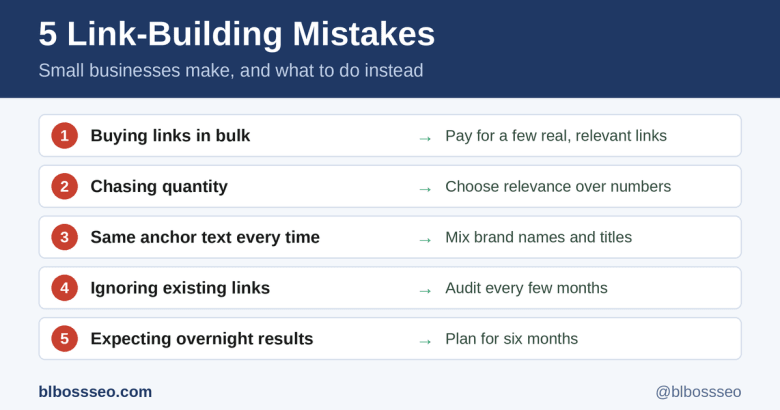
Quick summary table
|
Mistake |
What to do instead |
|---|---|
|
Buying links in bulk |
Pay for a few links from real, relevant sites |
|
Chasing quantity |
Choose relevance over numbers |
|
Same anchor text every time |
Mix brand names, titles, and plain URLs |
|
Ignoring existing links |
Audit your link profile every few months |
|
Expecting overnight results |
Plan for six months and track monthly |
Frequently asked questions
What is the biggest link-building mistake? Buying cheap links in bulk. They are usually low quality, rarely help, and can make your link profile look manipulated.
How many backlinks does a small business need? There is no fixed number. A small set of relevant, trusted links usually beats a large set of weak ones.
How long does link building take to work? Early signs often appear after 2 to 4 months, with clearer results over 6 to 12 months.
Should I use the same anchor text for every link? No. Mix brand names, page titles, plain URLs, and generic phrases so your link profile looks natural.
The bottom line
Good link building is slower and quieter than the shortcuts promise, but it lasts. Focus on relevance, vary your anchor text, check what you already have, and be patient. Your rankings will reflect it.
Before you add your next link, run through our on-page SEO checklist to make sure the page it points to is ready.