How to Choose a Link Building Service: 7 Questions to Ask
Hiring a link building service can save you time, but it can also waste your budget if you pick the wrong one. The market is full of cheap packages, big promises, and vague reports, and it is hard to tell the good providers from the bad ones.
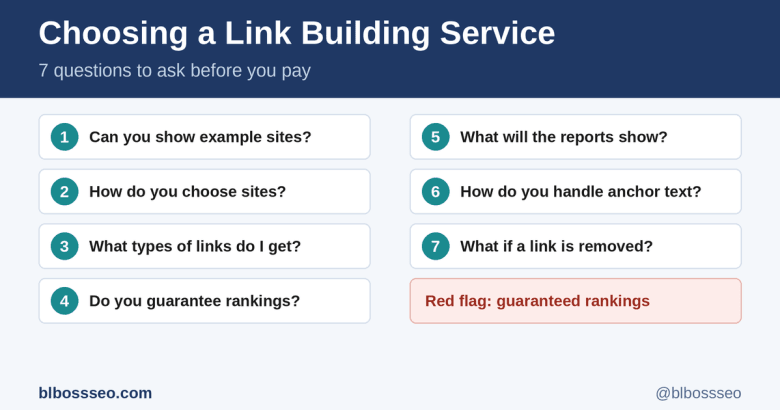
The easiest way to protect yourself is to ask the right questions before you pay. Here are seven that separate serious providers from risky ones.
1. Can you show me example sites where you place links?
A good provider will show you real examples of sites they work with, or at least describe them clearly: topic, traffic level, and type of content. If they refuse to share any examples, you cannot judge the quality of what you are buying.
Good sign: Specific examples or a sample list of sites. Warning sign: "Our network is private" with no details.
2. How do you choose which sites to approach?
The answer should be about relevance. Look for providers who match sites to your topic, check that the site has real content and real readers, and avoid sites that sell links to anyone.
Good sign: They talk about relevance, real traffic, and editorial standards. Warning sign: They talk only about numbers, such as how many links you will get.
3. What type of links will I receive?
Ask exactly what you are paying for: guest posts, resource page links, mentions in existing articles, or directory and profile links. Our guide to guest posts vs. profile backlinks explains why these types differ so much in value.
Good sign: A clear description of the link types and where they appear. Warning sign: Vague terms like "high-power links" or "tier 2 blasts."
4. Do you guarantee rankings?
No honest provider can guarantee a specific ranking, because search engines make the final decision. A provider can promise a process, delivery of a set number of placements, and clear reporting. They cannot promise position one.
Good sign: Guarantees about the work delivered, such as placements and reports. Warning sign: Promises of page-one rankings in a fixed number of days.
5. What will the reports show?
You should see the exact URL of each link, the site it is on, the anchor text, and the date it went live. Without this, you cannot check the work or audit it later. You can use our step-by-step backlink audit guide to verify what you receive.
Good sign: A report listing every link with a live URL. Warning sign: A report showing only totals, such as "500 links built."
6. How do you handle anchor text?
A natural link profile uses a mix of brand names, page titles, plain URLs, and generic phrases. Ask how the provider chooses anchor text and whether you can approve it.
Good sign: Varied, brand-focused anchors that you can review. Warning sign: The same exact keyword phrase used for every link.
7. What happens if a link is removed or the site is penalised?
Links can disappear, and sometimes a site drops out of search results. Ask whether the provider replaces lost links and for how long, and whether the price covers it.
Good sign: A clear replacement policy. Warning sign: No policy, or "all sales are final."
Quick comparison table
|
Question |
Good answer |
Red flag |
|---|---|---|
|
Example sites? |
Real examples shared |
Refuses to show any |
|
Site selection? |
Relevance and real traffic |
Only link counts |
|
Link types? |
Clearly described |
Vague jargon |
|
Guarantees? |
Work delivered |
Guaranteed rankings |
|
Reports? |
Every live URL listed |
Totals only |
|
Anchor text? |
Varied and approved |
One keyword repeated |
|
Replacement? |
Clear policy |
No policy |
Red flags to avoid completely
- Thousands of links for a few dollars
- Guaranteed first-page rankings
- Links delivered all within a day or two
- No named person or company to contact
- Pressure to pay immediately with no questions answered
If you want to learn what such links look like, read our guide on how to spot spam backlinks.
How much should a link building service cost?
Prices vary widely by country, quality, and link type. As a rule, genuine placements on relevant sites with real content cost far more than bulk packages, because editors, writers, and outreach time are involved. If a price looks too low for the work described, the work is probably not what it appears to be.
Frequently asked questions
Is a link building service worth it? It can be, if you lack the time or contacts for outreach and choose a provider that focuses on relevant, real sites.
How long until I see results from a link building service? Early movement often appears in 2 to 4 months, with clearer results over 6 to 12 months. See our answer to how long SEO takes.
Can I do link building myself instead? Yes. Guest posting, creating useful resources, and building relationships with other site owners all work, but they take time.
How many links should I buy per month? Quality matters more than quantity. A few relevant placements a month usually beats a large batch of weak links.
Final thoughts
The best link building services are open about their methods, honest about results, and focused on relevance rather than volume. Ask the seven questions above, compare the answers, and walk away from anyone who avoids them.
Before you start, make sure your own pages are ready by running through our on-page SEO checklist.